Momus (2026)
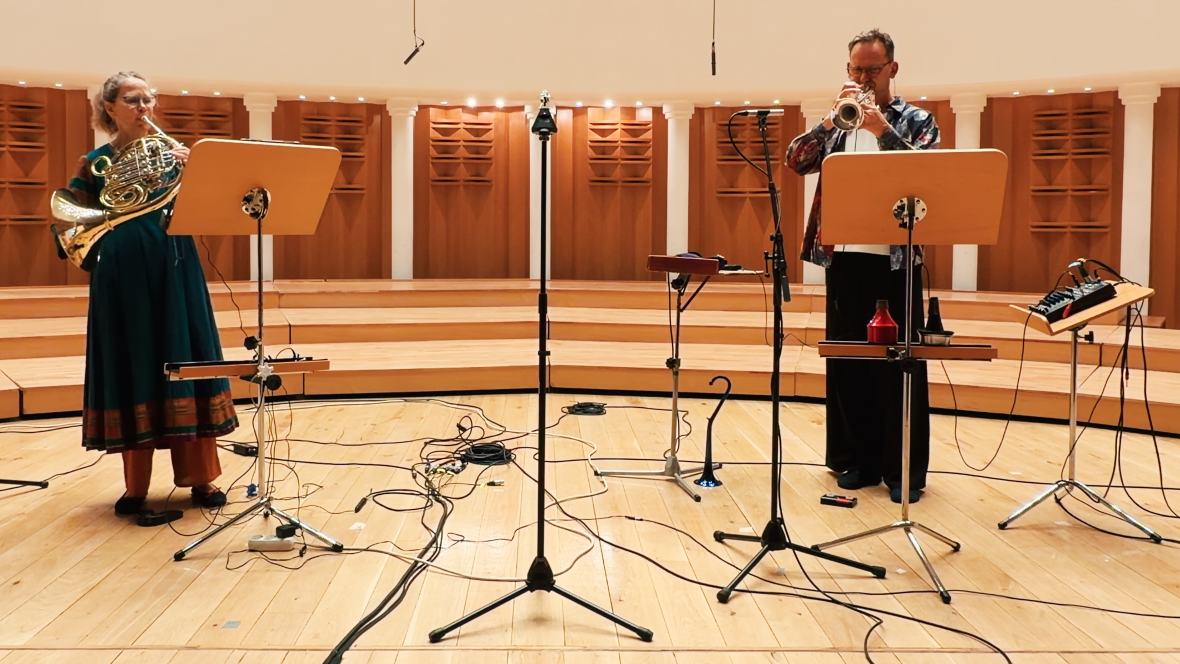
It was Momus’ goal to find fault in anything and everything so that he could ridicule it.
Momus is the Greek god that is the personification of satire and mockery. This piece depicts a ritual for summoning Momus. The followers gather, the High Priestess arrives, incantation begins, the choir sings, Momus gives a sign, and finally, he arrives.
"Harmonic" structure
I used warped harmonies induced by stretched and compressed overtones of the flexible additive synthesizer I wrote in Max. It can function both as an additive synth where you can stretch/compress its overtones, and make it non-harmonic, also as an analysis/synthesis tool, that extracts the overtone structure of an audio input in real-time, and synthesizes the same overtone distribution, with an option to stretch and compress the audio sample's overtones.
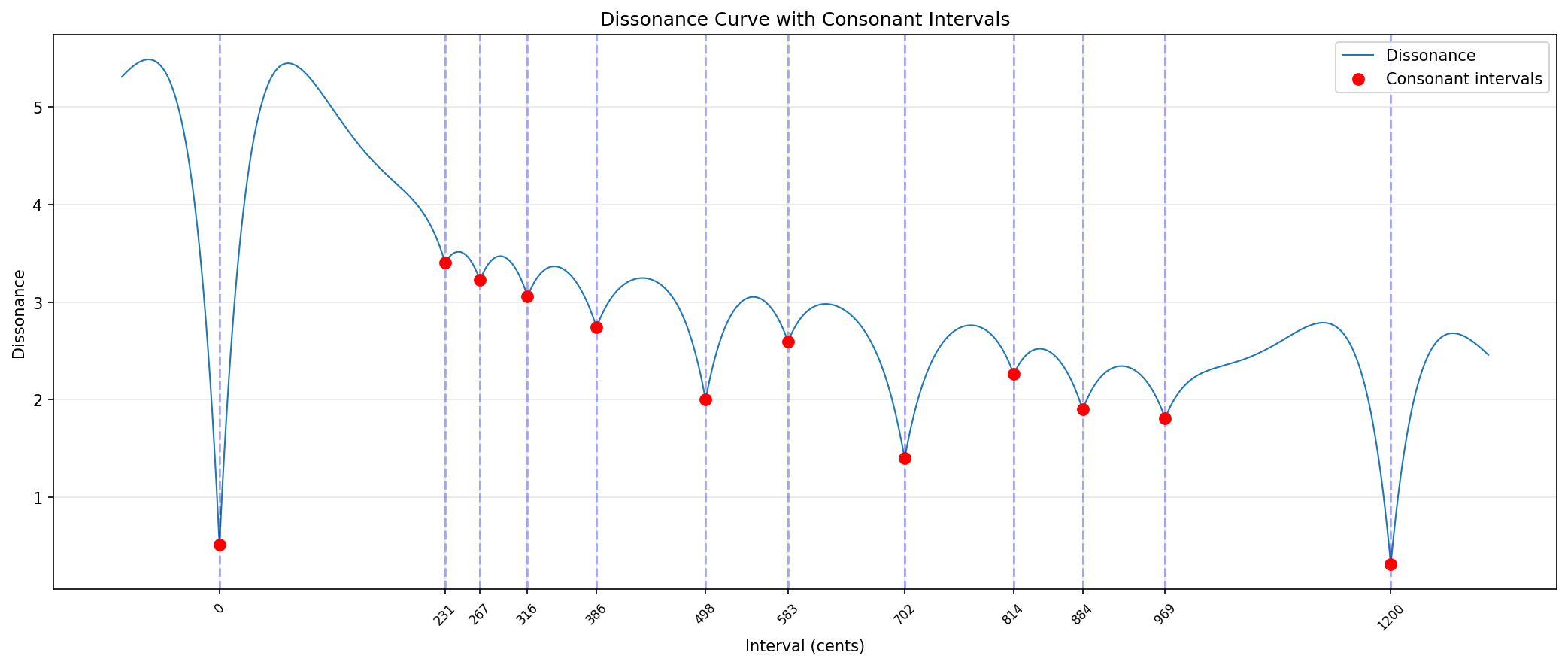
I say "warped harmonies induced by stretched/compressed overtones" in the sense of Sethares. Briefly, he has introduced a method to calculate sensory dissonance of a certain interval, based on an instrument's overtone structure. When you plot the dissonance of intervals for an instrument with harmonic overtones, you see sharp minima at the usual just intonation intervals.
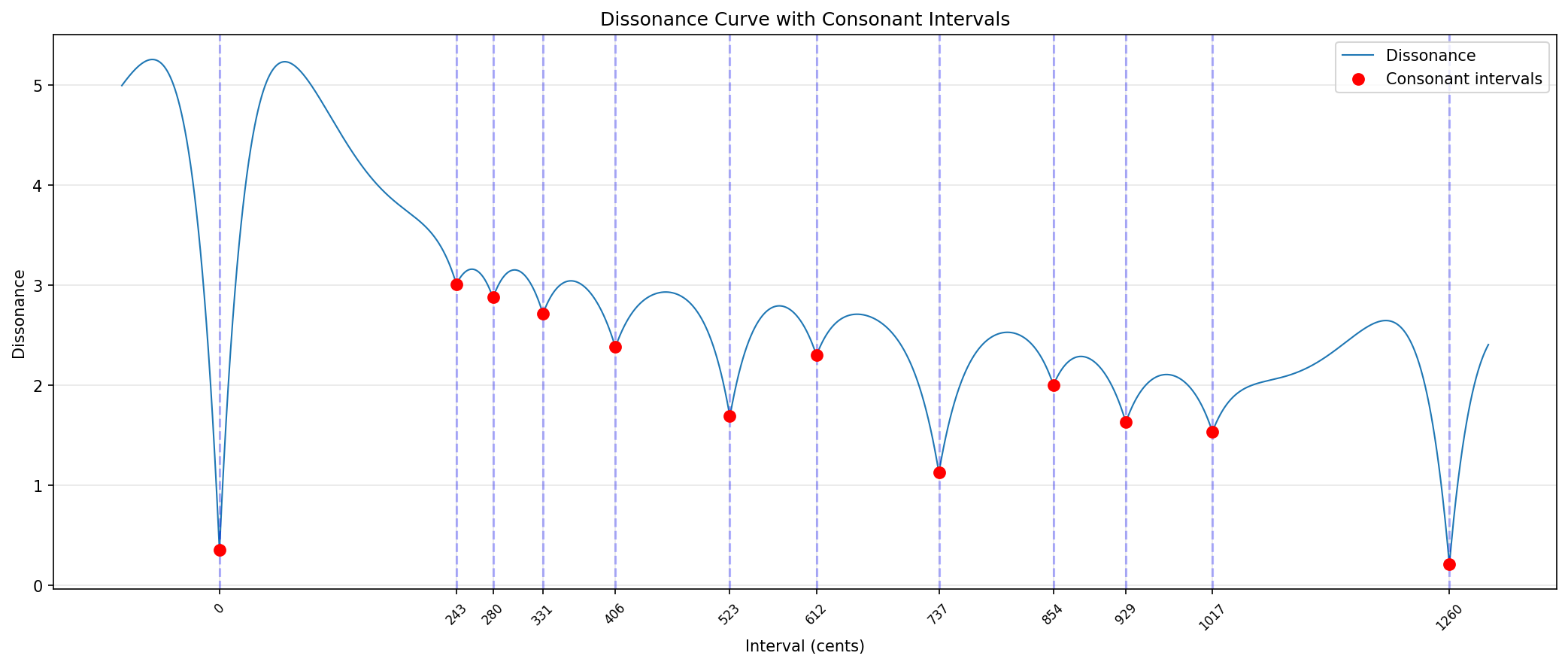
If we are dealing with instruments with non-harmonic overtones, such as bells, we get consonances at different intervals. It is really interesting that Gamelan instruments non-harmonic overtones and the scales used in this music can be derived from the same calculation. For an imaginary instrument with overtones that are 5% stretched, we see that the consonant minima are expanded.
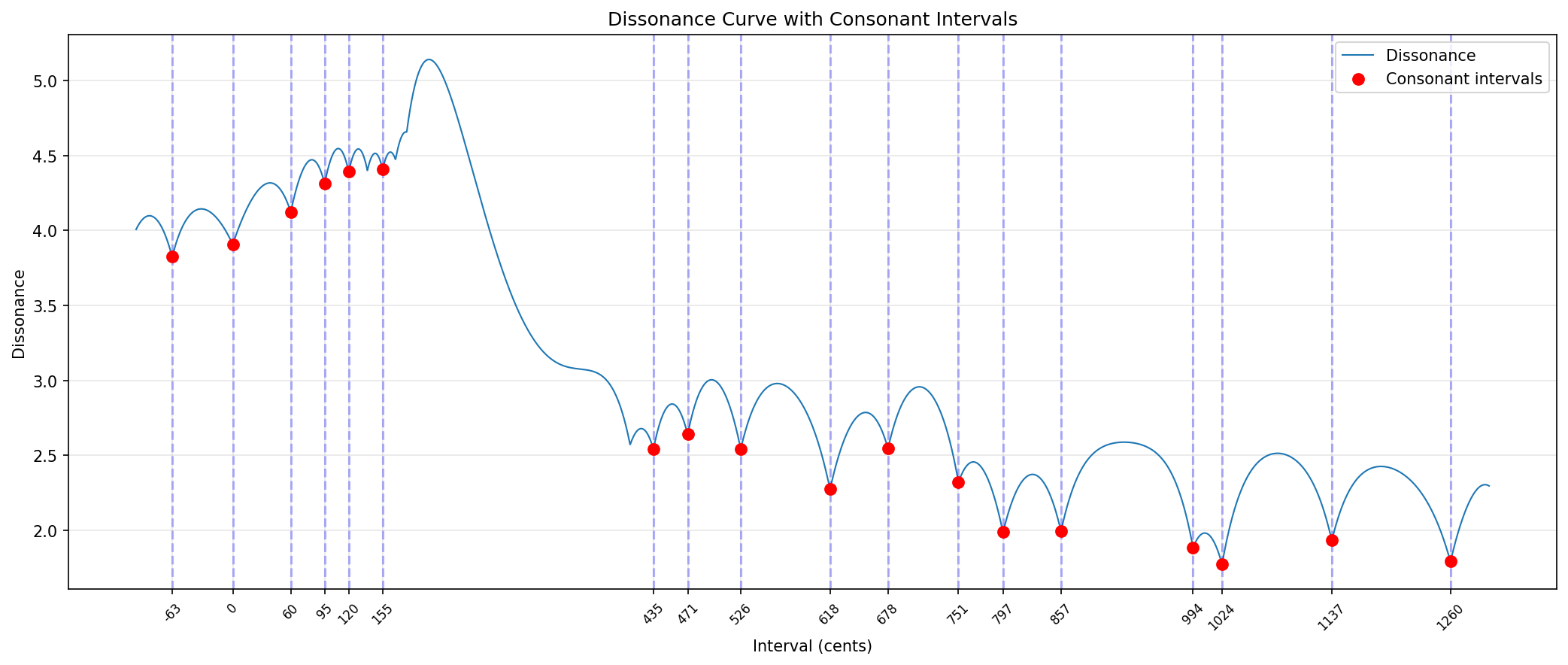
With my Max patch, I had an instrument with any overtone distribution I want. However, overtones of the horn and trumpet remained more or less harmonic. So I calculated the dissonance curve of intervals played by an harmonic instrument on top of a non-harmonic instrument. That is where the "warped harmonies" come from.
I have continuously changed overtone stretch amount, while also shifting the fundamental frequnecy, such that certain overtones stayed the same, perceived pitch became ambiguous, and timbre became bell like.
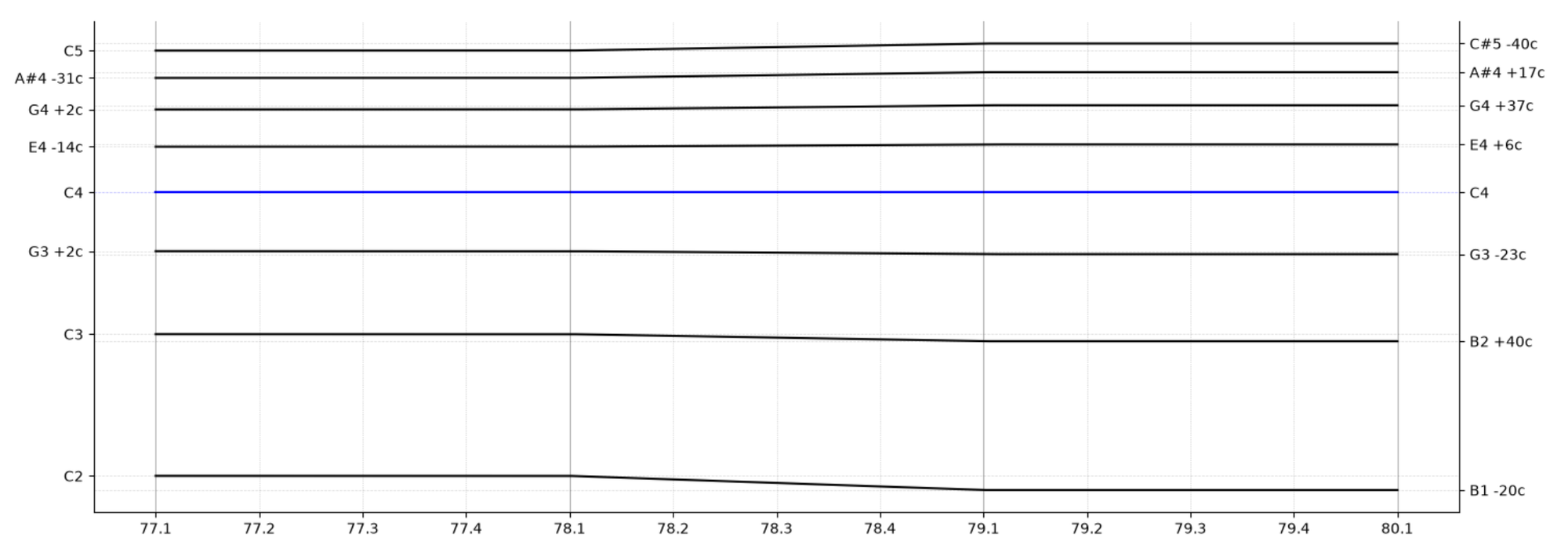
While the synth plays a sound with partials seen in the image, the trumpet can play C4 the entire time and stay consonant. If the horn was playing C3 at the same time, it has to fall to around C3 quarter-tone-flat. C4 natural and C3 quarter-tone-flat are highly dissonant, but they are both consonant with the stretch overtones.
But ultimately, "There is no theory. You have only to listen. Pleasure is the law." (Claude Debussy).
.